1. Introduction
Urban traffic congestion remains one of the most persistent and politically salient challenges in cities characterized by high levels of automobile dependence. For decades, public agencies have responded with a familiar toolkit: roadway expansion, grade-separated intersections, parking provision, traffic operations improvements, and, more recently, expectations that vehicle-centered technologies, such as autonomous vehicles, may help alleviate congestion. At the same time, many cities have also invested in public transit, bicycle infrastructure, pedestrian improvements, curb management, and travel demand management. Yet even where such interventions have been implemented, the broader urban system often remains defined by extensive car use, long trip distances, high household transportation burdens, substantial land consumption, and recurring congestion. This pattern helps explain why multimodal reforms so often underperform in strongly car-centric urban systems.
This paper argues that these failures are rooted not only in weak implementation or insufficient funding but in the persistence of a dominant planning paradigm. In many metropolitan contexts, transportation planning continues to privilege vehicle throughput, peak-period speed, roadway hierarchy, dispersed land use, and auto-oriented standards and performance measures. Within such a framework, multimodal improvements are expected to operate inside a system fundamentally optimized for automobile movement. As a result, they may succeed locally while failing to produce metropolitan-scale transformation.
To analyze this problem, the paper draws on Thomas Kuhn’s theory of paradigms and scientific change. Kuhn developed this framework to explain how scientific communities stabilize around dominant problem-solving models, accumulate unresolved contradictions, and, under certain conditions, revise their foundational assumptions (Kuhn 1962). Although transportation planning is not a natural science in the same sense as the disciplines Kuhn examined, his concepts provide a useful analytical vocabulary for understanding how planning systems define problems, privilege methods, and resist fundamental change. In this paper, car-centric transportation planning is treated as a dominant planning paradigm: a framework that shapes what counts as a legitimate transportation problem, which interventions appear appropriate, and which performance measures define success.
The paper does not claim that Kuhn replaces existing transportation scholarship. Research on automobility, path dependency, induced demand, and socio-technical transitions already provides strong explanations for why automobile-oriented systems persist. Kuhn adds a distinct perspective by clarifying three issues that are especially important in transportation planning. First, he draws attention to unresolved contradictions that accumulate within the dominant framework. Second, he helps explain why competing mobility approaches often rely on conflicting metrics and evaluative logic rather than simply different tools. Third, he provides a language for understanding how accumulated contradictions can weaken confidence in the prevailing planning paradigm and make alternatives more thinkable.
The article is best understood as a conceptual framework paper with structured empirical illustration. Its aim is not to present a completed causal model or a full comparative case-study analysis but to develop an analytical framework that can guide comparative research and policy interpretation. To avoid using Kuhn merely as a metaphor, the paper defines explicit criteria for what counts as an anomaly, a crisis, and a paradigm shift in transportation systems. It then applies those criteria through three forms of illustration: first, a comparison between car-centric and accessibility-based planning logics; second, built-form evidence from U.S. downtowns showing how network permeability and activity intensity relate to non-auto travel; and third, an examination of post-disruption recovery as a policy window in which cities may either reproduce or weaken car-centric lock-in.
Three propositions organize the analysis.
The paper proceeds as follows. Section 2 positions the Kuhnian framework in relation to adjacent literatures. Section 3 defines the methodological approach and analytical criteria. Section 4 applies Kuhn’s core concepts to transportation systems. Section 5 explains the persistence of car-centric systems through path dependency, urban form, and feedback dynamics. Section 6 identifies the relevant alternative as an accessibility-based multimodal mobility paradigm. Section 7 provides structured empirical illustrations, including built-form evidence and recovery-oriented examples. Section 8 discusses implications for policy and practice. Section 9 concludes.
2. Applying Kuhn’s Framework to Urban Transportation
Kuhn developed his framework primarily through examples from the natural sciences, including astronomy, physics, and chemistry. He did not write about transportation planning. Even so, his ideas about paradigms, anomalies, incommensurability, and crisis provide a useful lens for examining persistent contradictions in urban mobility systems. In this paper, Kuhn is not treated as a literal model of transportation change but as a bounded analytical framework for understanding why dominant planning logics remain stable even when their limitations become increasingly visible.
The literature on automobility and car dependence is already substantial. Scholars have shown how private vehicles become embedded in infrastructure, social routines, public policy, land development, and cultural identity (Sheller and Urry 2006). Path dependency scholarship explains how early decisions and increasing returns can lock systems into trajectories that become progressively more difficult to reverse (David 1985; Arthur 1989). The induced-demand literature demonstrates that expanding road capacity frequently generates additional travel and erodes congestion relief over time (Duranton and Turner 2011; Hymel 2019). Socio-technical transition theory, especially the multi-level perspective, explains how stable regimes persist, how niche innovations emerge, and under what conditions regime change may occur (Geels 2002; Geels and Schot 2007).
Within this broader field, Kuhn contributes an additional perspective rather than a substitute framework. First, Kuhn directs attention to anomalies: recurring contradictions that cannot be fully resolved within the dominant planning logic. In transportation, examples include congestion that returns after capacity expansion, persistent accessibility deficits despite high infrastructure spending, continuing exposure to severe traffic injury, and environmental burdens that remain difficult to reduce in systems organized around high levels of automobile travel. Path dependency explains why such systems endure; Kuhn helps clarify why their unresolved contradictions matter analytically.
Second, Kuhn foregrounds incommensurability, which is especially salient in transportation planning. Car-centric practice often defines success through vehicle delay, speed, and roadway Level of Service, whereas accessibility-oriented planning emphasizes access to destinations, multimodal reliability, safety, resilience, and equity. These are not merely different technical indicators. They reflect different understandings of mobility itself. Kuhn helps explain why competing planning approaches often speak past one another: they are not simply proposing different tools but advancing different evaluative logics.
Third, Kuhn emphasizes crisis and legitimacy. Socio-technical transitions scholarship is highly effective at explaining regime stability and niche development, but Kuhn contributes a sharper account of how accumulated contradictions can weaken the legitimacy of the dominant framework. In transportation, a crisis does not mean congestion alone. It refers to a broader recognition that congestion, safety burdens, inequitable access, environmental externalities, fiscal strain, and repeated rebuilding remain unresolved under the prevailing toolkit.
The value of the Kuhnian framing, therefore, lies not in relabeling established critiques with new terminology but in clarifying the relationship between unresolved contradictions, conflicting metrics, and the weakening legitimacy of a dominant planning logic.
3. Methodological Approach and Analytical Criteria
This article is a conceptual framework paper with structured empirical illustration. Its purpose is not to report the results of a completed quantitative study but to construct and refine an analytical framework that can inform comparative and empirical research in transportation planning. The argument proceeds in four steps.
To avoid metaphorical overreach, the paper uses Kuhn’s terms in a bounded and explicit way.
Under this formulation, not every transportation problem constitutes an anomaly, and not every anomaly amounts to a crisis. An anomaly is a contradiction that remains difficult to resolve using the routine tools of the prevailing framework. A crisis occurs when such anomalies accumulate across several domains simultaneously, including congestion, accessibility, safety, emissions, fiscal burden, and system fragility, such that incremental problem-solving no longer appears adequate.
In this paper, paradigm translation refers to the institutional work required to convert an emerging alternative paradigm into operating practice. This includes revising project evaluation criteria, design manuals, budgeting priorities, agency mandates, and performance reporting so that new goals are not merely stated but govern actual decisions.
This framing also clarifies the paper’s scope. The argument is not that one paradigm instantly replaces another, nor that pure paradigms exist in practice. In most cities, elements of multiple planning logics coexist. The analytical question is which goals and metrics remain dominant and under what conditions they begin to shift.
4. Kuhn’s Framework Applied to Car-Centric Transportation
4.1. Paradigm and Normal Problem-Solving
In Kuhn’s account, a paradigm structures what a field treats as legitimate problems, methods, and solutions. Applied to urban transportation, the car-centric paradigm privileges a specific understanding of mobility: efficient movement of private vehicles across a metropolitan system organized by roadway hierarchy and dispersed land uses. This paradigm is embedded not only in engineering practice but also in urban form, infrastructure finance, land-use regulation, and public expectations.
Within this framework, normal problem-solving takes familiar forms: road widening, grade-separated intersections, intersection channelization, parking expansion, signal optimization, and traffic operations aimed at reducing delay. These measures may improve conditions in limited circumstances, but they operate within a broader logic that defines success narrowly and leaves the underlying system structure intact.
4.2. Anomalies
Strongly car-centric systems generate several recurring contradictions that fit the analytical definition of anomaly.
A central example is induced demand. When roadway expansion reduces travel time in the short run, it can attract additional trips, route changes, time shifts, and longer-distance development, ultimately eroding the initial congestion benefit (Duranton and Turner 2011; Hymel 2019). In the present analysis, induced demand matters not only as an empirical phenomenon but also as a paradigmatic one: it shows how a routine response may reproduce the conditions that cause the original problem to recur.
The environmental contradiction also requires precise treatment. In many metropolitan contexts, high levels of automobile travel contribute materially to transportation-sector greenhouse gas emissions, local air pollution exposure, and land-consumptive urban form associated with extensive paved surfaces. Vehicle electrification can reduce tailpipe emissions, but it does not by itself resolve congestion, crash exposure, parking intensity, long trip distances, or the accessibility deficits associated with dispersed settlement patterns. Thus, even when vehicle technologies improve, several core contradictions of the car-centric system remain.
4.3. Crisis
In this paper, a crisis does not mean a single event. It refers to a condition in which unresolved contradictions accumulate over time, eroding confidence in the dominant planning approach. A transportation system enters a crisis when its usual tools no longer appear capable of achieving widely accepted goals. This can happen when congestion persists despite major spending, safety problems remain high, non-drivers still lack reasonable access, climate-related burdens increase, and repeated rebuilding fails to restore a system that remains fragile and unequal.
Crisis is therefore multidimensional. A city may tolerate congestion for many years so long as access remains acceptable and burdens are politically manageable. But when congestion coexists with high household transportation costs, poor access for non-drivers, severe safety inequities, fiscal stress, and vulnerability to disruption, the legitimacy of vehicle-throughput planning is more likely to be questioned.
4.4. Incommensurability
One of Kuhn’s most useful contributions in this context is the idea of incommensurability. In transportation, this appears when competing planning frameworks define success differently.
This distinction matters because it shapes policy choice. An intervention that increases vehicle speed may worsen pedestrian safety or transit reliability. Conversely, a project that reduces vehicle LOS may increase total access, person-throughput, and safety. If agencies continue to evaluate such trade-offs primarily through throughput-based measures, many alternative interventions will appear deficient even when they perform better on broader mobility goals.
5. Why Car-Centric Systems Persist: Path Dependency, Urban Form, and Feedback Dynamics
The persistence of car-centric systems cannot be explained by paradigm theory alone. Path dependency and systems thinking are essential complements.
Path dependency shows how early investments, regulations, and norms become self-reinforcing. In many U.S. metropolitan areas after World War II, highway construction, single-use zoning, mortgage finance patterns, parking requirements, and roadway design standards reinforced development patterns that increased trip lengths and automobile dependence. These decisions created durable investments in infrastructure and land use while also shaping expectations about where people live, where jobs are located, and how people make daily trips.
Arthur’s notion of increasing returns helps explain why such systems become progressively harder to change (Arthur 1989). Each additional roadway, parking facility, and low-density development can make the automobile system more convenient for current users while making alternatives more difficult to provide effectively. This does not mean transition is impossible, but it does mean that reform must confront more than technical problems. It must also address the built environment and institutional rules that have accumulated over time.
Systems thinking adds a second layer of explanation. Urban transportation outcomes emerge from interactions among roadway supply, land use, travel behavior, pricing, and institutional rules. Measures intended to reduce congestion can trigger adaptive responses that recreate the original condition. Road expansion may induce additional demand; abundant parking may normalize driving; dispersed development may reduce transit viability; and poor walking conditions may suppress short non-auto trips. These feedbacks help explain why isolated interventions often deliver only temporary relief.
The built environment is especially important. Street-network structure and land-use intensity do not merely shape urban form in the abstract; they influence travel behavior directly by affecting route choice, trip length, accessibility, and the viability of non-automobile modes. This point is consistent with the broader built-environment literature linking density, diversity, and design to travel outcomes (Cervero and Kockelman 1997; Ewing and Cervero 2010). It is also consistent with the author’s related work on central business district walkability, which finds that more connected street networks, especially higher densities of -leg and -leg intersections, together with strong employment intensity, are strongly associated with higher walk and transit commuting shares across 50 U.S. CBDs (Iravani 2026). Although that study concerns CBDs rather than metropolitan systems as a whole, it supports a central claim of the present paper: framework variables are structural, not incidental.
5.1. Recovery, Rebuilding, and the Risk of Renewed Lock-In
Path dependency becomes especially consequential during periods of rebuilding. After a disruptive event, major spending and design decisions are often made quickly, under pressure to restore normal activity. What is rebuilt first, and according to which standards, can shape the mobility system for decades.
If recovery is defined primarily as restoring traffic flow and replacing roadway capacity as quickly as possible, rebuilding can reproduce the same car-first system and intensify long-term lock-in. Parking supply may be reinstated by default, vehicle speed may regain priority, and transit, walking, and cycling improvements may be treated as secondary or temporary. Once those investments are made, later changes become more expensive both financially and politically.
Recovery can also function as a policy window for transition. During rebuilding, cities can revise design standards, project evaluation methods, and funding priorities before new investments harden into another long cycle of path dependence. In Kuhnian terms, disruption does not itself create a paradigm shift, but it can accelerate recognition that the old toolkit is insufficient and make alternative goals more institutionally actionable.
6. The Alternative Paradigm: Accessibility-Based Multimodal Mobility
A persistent weakness in many critiques of car-centered planning is that they do not clearly define a transportation-focused alternative. The relevant alternative here is not simply “urban design” in the abstract, nor a narrow substitution of transit for cars. It is an accessibility-based multimodal mobility paradigm.
In this paradigm, the primary objective of transportation planning is not to maximize vehicle movement but to enable reliable, safe, and equitable access to opportunities across multiple modes and spatial scales. This includes local access to daily needs, corridor-scale movement of people, and regional access to employment, education, and services. Cars remain part of the system, but they no longer define the dominant measure of success.
This framing addresses a key conceptual issue raised in critiques of car-centric planning: the alternative must remain transportation-focused and address both regional mobility and neighborhood quality. Accessibility-based multimodality does so by treating walking, cycling, buses, rail, shared mobility, and cars as coordinated components of one system. The key difference is that no single mode, especially the private automobile, defines the evaluative logic for the entire network.
Urban design principles associated with Jacobs and Calthorpe remain relevant within this alternative, but they are better understood as built-form and land-use conditions that support an accessibility-based mobility paradigm rather than as the paradigm itself. Their value lies in shortening trips, improving permeability, concentrating destinations, and increasing the feasibility of non-automobile travel.
7. Structured Empirical Illustrations
Although this paper is not a full comparative case-study article, the argument benefits from empirical grounding. This section therefore provides structured illustrations showing how the framework can be applied to observable planning contexts. The purpose is not to establish definitive causal claims through original metropolitan-scale statistical analysis but to demonstrate that the distinctions developed in the paper correspond to recognizable differences in urban structure, planning logic, and recovery strategy.
7.1. Built-Form Evidence from U.S. Downtowns
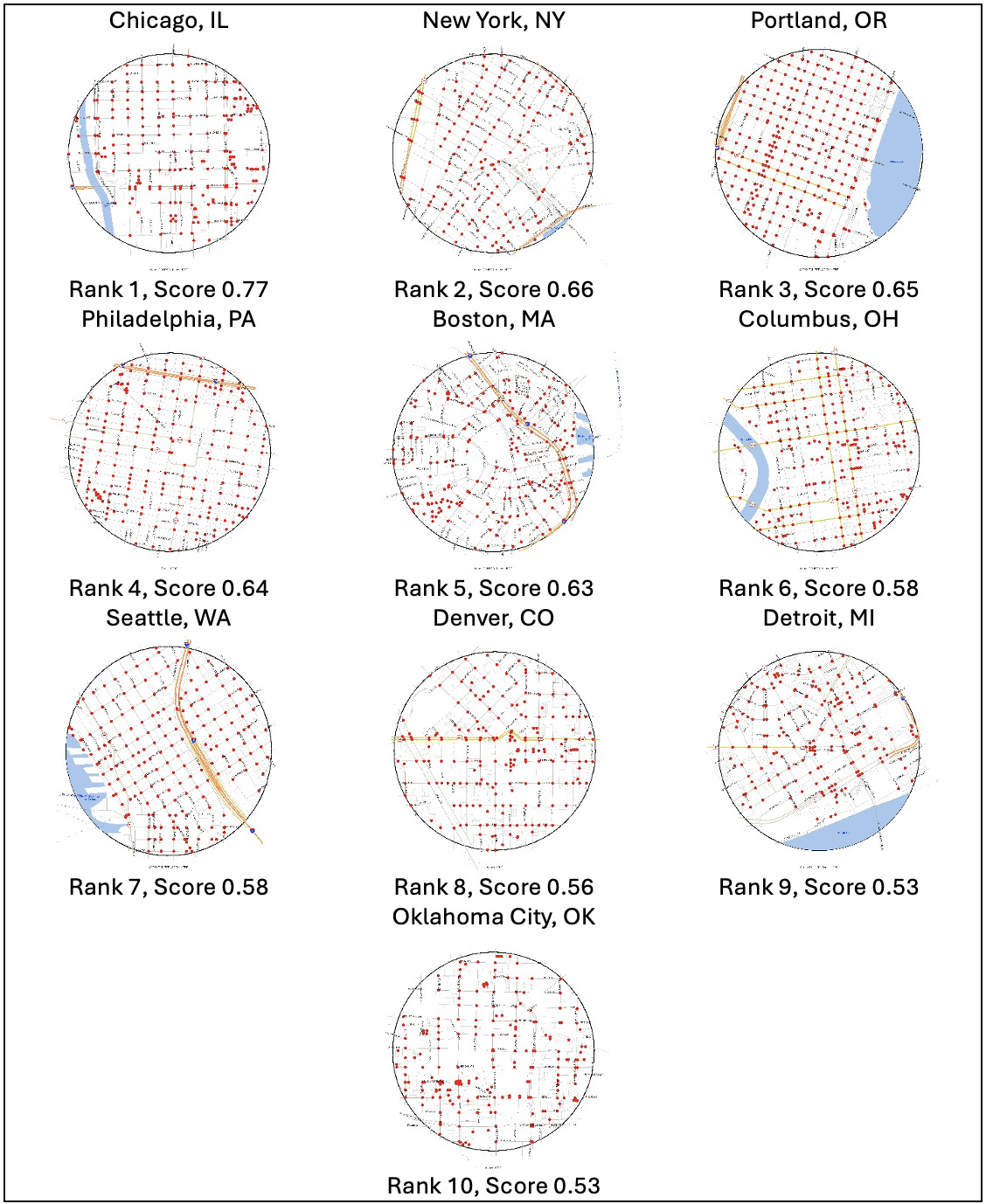
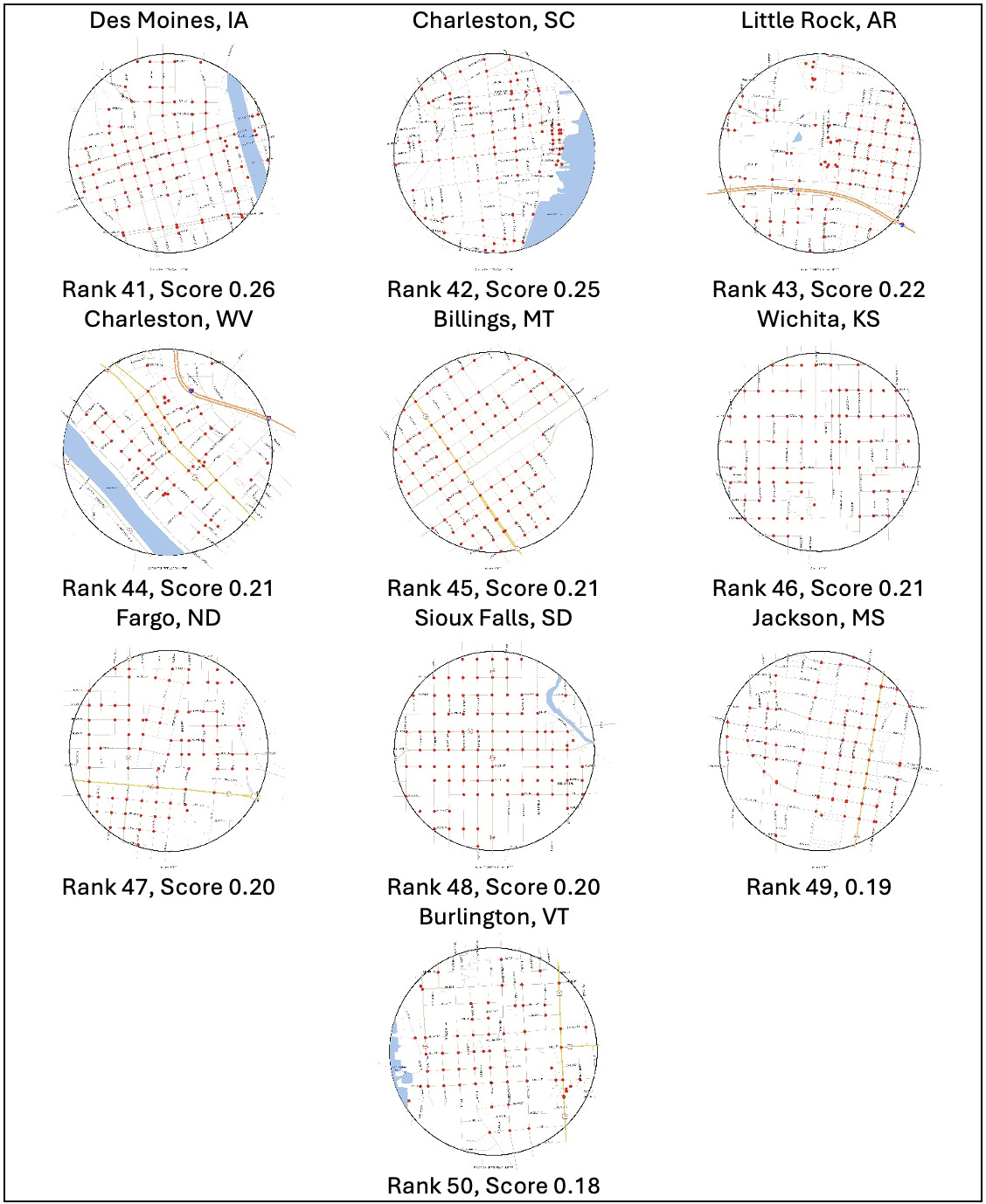
Evidence from the author’s related study of central business district walkability supports the argument that urban framework variables materially shape travel behavior. Using standardized one-mile-diameter CBD windows across U.S. cities, the study finds that street-network permeability, especially higher densities of -leg and -leg intersections, together with strong employment intensity, are strongly associated with higher walk and transit commuting shares (Iravani 2026). Although CBDs are only one component of metropolitan systems, the findings reinforce a broader point developed here: network structure and activity concentration are not minor background conditions but important determinants of access without a car.
For the purposes of the present paper, the highest- and lowest-ranked CBDs from that study serve as structured illustrations. Within the same one-mile CBD window, higher-ranked downtowns exhibit denser, more continuous patterns of connected intersections, while lower-ranked downtowns exhibit weaker connectivity and less supportive built form. These contrasts do not prove a full metropolitan paradigm on their own, but they show how connected urban structure supports non-auto mobility in ways that vehicle-focused operations alone cannot reproduce.
7.2. A Structured Metropolitan Contrast
The distinction between paradigms can also be illustrated through a stylized metropolitan contrast. Strongly car-centric metropolitan areas typically exhibit hierarchical arterial and freeway systems, large blocks, extensive parking supply, separated land uses, and performance evaluation centered on delay reduction and traffic flow. More accessibility-oriented metropolitan contexts tend to combine stronger transit networks, finer-grained street connectivity, higher destination concentration, and policy evaluation based more on access, reliability, and multimodal integration.
This contrast is intentionally stylized. Its purpose is not to rank cities absolutely but to show how differences in network form, land use, and performance logic correspond to different mobility outcomes and planning choices.
7.3. Dutch Traffic Safety Crisis and Paradigm Translation
A historically important illustration of paradigm translation can be found in the Netherlands, especially from the 1970s onward. Like many affluent countries in the postwar era, the Netherlands experienced rapid growth in automobile ownership and increasing pressure to reorganize urban streets around motor vehicle movement. In this context, rising traffic volumes were accompanied by serious safety consequences, including high numbers of traffic fatalities and increasing public concern over the exposure of children to traffic danger. These tensions became politically salient through protest and advocacy, including the well-known ‘Stop de Kindermoord’ movement, which challenged the assumption that rising motorization should continue to define street design and mobility policy (Pucher and Buehler 2008).
From the perspective developed in this paper, the Dutch case is significant not because it represents an instantaneous or total rejection of the automobile, but because it illustrates how persistent anomalies, especially traffic danger and the loss of safe urban access, can undermine the legitimacy of an established planning logic. The policy response that followed did not simply add isolated bicycle facilities within an otherwise unchanged system. Over time, Dutch cities and national institutions revised street design practices, expanded cycling infrastructure, calmed local streets, and increasingly treated safety and accessibility, rather than vehicle speed alone, as central goals of mobility policy (Pucher and Buehler 2008).
Amsterdam is a prominent example within this broader national shift. Its current cycling-oriented environment did not emerge solely from cultural preference, it was supported by institutional change, redesigned streets, and sustained public investment. In Kuhnian terms, the Dutch case illustrates a process of paradigm translation in which emerging goals were converted into enduring standards, investments, and street-management practices. It also shows that paradigm change in transportation is rarely instantaneous. Rather, it occurs through a gradual redefinition of what counts as a legitimate mobility problem and what kinds of outcomes are treated as successful.
7.4. Recovery as a Policy Window
Recovery and rebuilding provide another empirical illustration of the framework. After a major disruption, transport agencies and political leaders often face a choice between restoring pre-existing vehicular capacity as quickly as possible and using reconstruction to improve multimodal access and redundancy.
The analytical point is not that every transit-oriented or cycling-oriented system is automatically more resilient under every shock. Severe storms, floods, and heat events can disrupt transit, cycling, and roads alike. Rather, the relevant distinction concerns recovery logic. A car-centric recovery strategy seeks primarily to restore vehicle throughput and roadway capacity. An accessibility-oriented recovery strategy asks how essential access can be maintained across multiple modes, how vulnerable users can reach daily needs, and how rebuilding can reduce rather than reproduce long-term dependence on a single dominant mode.
This distinction helps clarify why recovery matters in a Kuhnian analysis. Disruption can expose anomalies already present in the system, such as a lack of redundancy, dependence on long trips, and inequitable access. Whether those anomalies reinforce the existing paradigm or contribute to paradigm translation depends on how rebuilding goals are defined.
8. Implications for Policy and Practice
If the central problem is paradigm persistence rather than isolated project failure, then policy must address not only infrastructure but also metrics, governance, and sequencing.
Several implications follow. First, public agencies should reform performance measures. As long as vehicle speed and Level of Service remain primary evaluation tools, many accessibility-improving projects will continue to appear weak by definition. Metrics should instead include accessibility, person-throughput, multimodal reliability, safety, and access equity.
Second, demand management and curb and parking reform are essential. A region cannot meaningfully reduce car dependence while continuing to subsidize abundant parking and dedicating large shares of street space to vehicle storage and flow.
Third, transit priority must be treated as a network issue rather than a corridor exception. Bus lanes, signal priority, frequency improvements, feeder-system integration, and reliable transfer environments are especially important because they improve access across a wider geography than isolated capital projects alone.
Emerging technologies do not determine paradigm change by themselves. When deployed in a throughput-oriented system, tools such as adaptive signals, connected vehicle systems, smart-city traffic management, or autonomous driving are likely to optimize traffic flow rather than reduce automobile dependence. Their contribution depends on the governing metrics and institutional context. Within an accessibility-oriented framework, similar technologies can instead support bus priority, demand-responsive feeder service, safer street operations, curb management, and improved multimodal coordination.
Fourth, long-term land-use and street-network reform also matters because transportation outcomes are closely tied to urban structure. A multimodal paradigm requires not only better transit but also shorter trips, more connected networks, and more destinations that can be reached without depending exclusively on a car.
Finally, the recovery policy deserves explicit attention. In post-disruption rebuilding, agencies should screen capital decisions for whether they reproduce auto-dependency or expand multimodal access and redundancy. If rebuilding is judged only by how rapidly it restores vehicle flow, opportunities for paradigm translation will likely be lost.
9. Conclusion
This paper has argued that persistent failures in urban transportation are best understood not simply as isolated policy mistakes but as the result of a dominant planning paradigm that has reached important structural limits. Drawing on Thomas Kuhn, the paper has interpreted car-centric transportation planning as a framework organized around vehicle throughput, hierarchical roadway networks, dispersed land use, and auto-oriented standards and performance measures. Within this framework, recurring congestion, induced demand, inequitable access, safety burdens, fiscal strain, environmental externalities, and system fragility can be understood as unresolved contradictions of the prevailing model.
The paper has also clarified what Kuhn adds to related transportation research. Path dependency helps explain why car-centric systems persist, and socio-technical transition theory helps explain regime stability and change. Kuhn adds a useful perspective by showing how unresolved problems accumulate within a dominant framework, how competing planning approaches rely on different measures of success, and how these growing tensions can weaken confidence in the existing planning paradigm.
The paper has further shown that transportation outcomes are shaped not only by operations and capacity but also by the underlying urban framework. Street-network structure, land-use patterns, and activity concentration influence access and travel behavior in important ways. In this context, the relevant alternative to car-centric planning is an accessibility-based multimodal paradigm that supports both local and regional access through coordinated modes and revised performance measures. The Dutch experience, especially the shift toward safer and more cycling-supportive urban mobility after the traffic-safety crises of the 1970s, also illustrates that dominant transportation paradigms can change when persistent anomalies become politically salient and are translated into enduring design standards, investments, and policy priorities.
The central implication is that the dominant logic of transportation planning must change. As long as vehicle movement remains the primary measure of success, multimodal reforms will continue to be constrained by the system into which they are introduced. A more effective and equitable transportation future depends on shifting the basis of evaluation toward accessibility, safety, reliability, resilience, and broader access to opportunity. Periods of recovery and rebuilding are especially important because they expose existing contradictions and create rare opportunities to revise the standards, metrics, and investment priorities that otherwise reproduce car-centric lock-in.
AI Transparency Disclosure
A generative AI tool was used for language editing and structural refinement.
Disclosure Statement
The author declares no competing interests.