1. Introduction
National transport plans (NTPs) are strategic roadmaps that provide important guidelines for a country to achieve future goals regarding vital transport issues. They offer guidance on managing and improving the national transport infrastructure, thus ensuring fast and efficient movement of people or goods and helping the economy of a country grow. In the modern world, where the environmental issues are becoming increasingly relevant, a NTP can propose measures and solutions that can lead to environmental protection and sustainability by promoting transport practices that reduce CO2 emissions, utilize renewable energy sources, and do not irreversibly harm the natural environment. In addition, forward-looking NTPs can contribute to safety by ensuring that the transport infrastructure of a country is able to withstand unpredictable events or emergencies, such as natural disasters and pandemics. Moreover, a well-devised NTP can mitigate social exclusion and inequalities by providing access to education, healthcare and job opportunities for population groups of geographically isolated areas, thus improving the social welfare.
Sustainable development is a focal point of modern transport planning, as governments and international organizations attempt to build and maintain transport systems that are characterized by robustness, efficiency, financial feasibility, and ecological awareness. This attempt involves creating transport systems that serve the fundamental cause of moving people and goods, while simultaneously ensuring that the natural environment and resources are utilized efficiently and are also preserved and protected for the sake of the next generations. Urban mobility is an important aspect of the general philosophy of sustainable development that deals with promoting more sustainable ways of moving people and goods in the cities. By utilizing eco-friendly vehicles and renewable energy sources, promoting the use of public transport, prioritizing cycling lanes and walking areas, the goal is to reduce or even eliminate CO2 emissions and air pollution to render the urban environment more habitable, impede the factors that cause climate change, and improve the quality of life in the cities. Furthermore, urban mobility contributes to more efficient transport by making use of the latest technological advancements, such as Intelligent Transport Systems (ITS) that use real-time data for route planning and guidance, thus limiting excessive traffic and improving the level of service of the transport network.
Current freight transport-induced CO₂ emissions remain a significant component of global and national greenhouse gas outputs, particularly in road and maritime sectors. Freight transport accounts for over 30% of transport-related CO₂ emissions in the EU, with domestic road freight and international shipping both contributing large volumes, as trade and logistics activity continues to grow (Rigogiannis et al. 2023). Urban areas are estimated to account for around 70% of global CO2 emissions, particularly from energy use and fossil fuel combustion (e.g., Luqman et al. 2023; Lopez-Aparicio et al. 2025). Future planning to address these emissions are structured through multilevel governance frameworks, including the Paris Agreement, the New Urban Agenda, and the U.N. Sustainable Development Goals, which collectively foster compact urban form, low-carbon transport, and energy-efficient infrastructure. Emphasis is given to stringent regulatory targets, technological shifts, and modal changes. For instance, the International Maritime Organization (IMO) has set strategies to reduce shipping emissions by 20–70% by 2030–2040 and aim for net-zero around 2050, while the EU’s Fit for 55 package and related policies promote electrification, efficiency standards, carbon pricing, and shifts from road to rail or inland waterways to cut freight CO₂.
The purpose of this comparative analysis is to critically review the Greek national transport plan along with the examination of NTPs for other European Union (EU) and non-EU countries. Emphasis will be placed on various aspects of urban mobility and sustainable development, as they play an important role in modern transport planning. By comparing the various NTPs, similarities and differences will become evident regarding the approach that each country follows and the targets it sets, while trying to deal with the contemporary transport challenges. Moreover, by highlighting innovative ideas and best practices, a series of proposals are presented to improve the Greek national transport plan in terms of encouraging sustainable growth and enhancing urban mobility.
The purpose of this paper is to review and comparatively analyze the NTP and transport strategies of Greece in relation to those of other countries both in the EU and outside of it. The methodology of the paper involves the examination of these plans in terms of their potential to promote the mobility of goods and passengers, particularly in urban areas. Besides, the plans are examined with respect to their focus or prioritization to support wider (economic, social, governance and environmental) sustainability objectives. In turn, common features, differences, pending issues and implementation gaps are identified and the possible extent of policy transfer among countries is considered. The selection of countries was based on information availability and geographical criteria to ensure the representation of different areas of Europe and the world. The selected assortment of countries provides adequate variety to present how EU and non-EU countries with different socioeconomic, geographical and historical backgrounds, and institutional capacities deal with the modern challenges of the transport sector.
Moreover, we compare the performance of these countries and of their largest metropolitan areas in terms of environmental impact and accessibility. Studying the environmental performance and service quality conditions of the transport sector in major cities −although may present distinct characteristics than other smaller ones− is considered crucial. This is because they concentrate most of the population and economic activity, and highly influence mobility demand, accessibility pattens and modal shifts and, subsequently, labor markets, productivity and social equity at their own countries (Tsekeris 2026). These conditions make large urban agglomerations the primary sources of transport-related negative externalities, inefficiencies as well as drivers of sustainable development at the national scale. Therefore, this analysis can provide comprehensive evidence base for designing transport policies that simultaneously advance efficiency, national climate goals, public health, and inclusive economic development. According to the analysis made, it is found that Greece and the Athens metropolitan area have worse performance, in terms of the transport share of CO2 emissions and access to fixed-route transport systems, respectively, compared to other countries and metropolitan areas examined. Based on this outcome, the relevance and suitability of the Greek NTP are discussed, including suggestions for addressing existing gaps and improving the sector’s performance.
As far as the organization of the paper is concerned, Section 2 provides a review of scholarly literature focusing on the comparison of NTPs. Sections 3 and 4 present and discuss NTPs for selected EU countries, and for other countries outside the EU, respectively. Section 5 offers a comparative analysis among various NTPs, identifying common features, differences, and their relevance and suitability for addressing various problems. Section 6 concludes and reports implications for improving the transport sector based on NTPs.
2. Literature Review on Comparing NTPs
The appropriate integration of transport models into a national transport plan is a key factor for the effective planning and operation of transport and logistics infrastructure and services in the context of a national strategic development plan. Such a plan is typically linked to exploiting the country’s strategic geographical location, transforming it into a regional/international transport hub and improving the efficiency of the transport and logistics market. However, the expansion and implementation of the tools developed in the national transport planning requires the implementation of a series of steps with specific outcomes. Among others, such steps involve the modeling of production and attraction and distribution of passenger and freight flows, the choice of transport modes and network space allocation, the determination of transport system performance indicators, the prioritization of investment projects, the determination of the investment programme and the interactions between the national transport model and the strategic national development plan.
Despite the general guidelines followed by various national transport and logistics plans (Kanafani and Sperling 1982; Desmet et al. 2008; Benmaamar et al. 2015; Lyons and Davidson 2016; Fichert 2017; Oszter 2017; Zembri-Mary 2017; ITF 2020; USDOT 2020), the objectives, strategies and tools adopted and how the required investment projects are defined, prioritized, and linked to national development planning, can vary significantly between different countries around the world. Nowadays, NTPs have an increasingly significant role in supporting the national and regional transport authorities to coordinate their actions and address sources of inefficiency due to conflicting intra-modal, intermodal and cross-sectoral policy objectives. For instance, such policy conflicts may arise between international transport hub operators and national transport providers, and among operators of various transport networks in the same or different regions (Turner and Johnson 2017).
The existing literature comprises interesting studies and research papers that underline the impact of forward-thinking planning on developing transport systems that promote sustainability. The seminal paper of Schafer and Victor (2000) provides a model to forecast future transport trends for eleven regions and the world through the year 2050, concluding that there is a worldwide shift towards faster transport modes stemming from increases in income and demand for transport. Bertolini et al. (2008) dealt with the challenges that urban transport planning faces and proposed a shift from traditional planning methods to more integrated and collaborative strategies that require effective communication skills to mitigate conflicts and achieve a wide collaboration. Moreover, Hickman et al. (2013) supported that sustainable mobility in urban areas is attainable on the condition that there is substantial funding for improving transport infrastructure combined with strategic urban planning. Their paper presented a series of scenarios and strategies to describe future transport conditions in two different areas, London and Oxfordshire.
Comparative studies on transport policies contribute to a better understanding of various aspects and challenges of modern transport planning by presenting how different cities, countries, and regions deal with important transport issues, while also helping to identify innovative solutions and best practices. An earlier comparative analysis performed by Pucher (1995) consisted of two parts; first, he studied the urban passenger transport system in the United States and, second, how it differs from the European one. He focused on public policies regarding car ownership and taxation, public transport funding, land use, and their impact on ways in which urban transport has evolved in the two continents. He concluded that European policies have enabled a more balanced mobility profile between the use of car and public transport, whereas in the United States the use of car is more dominant due to lower population density and less supportive policies towards public transport and non-motorized means.
Pucher and Buehler (2008) used national aggregate data and case studies from different cities to investigate how the Netherlands, Denmark, and Germany have rendered cycling attractive to their citizens. They underlined the importance of education, cultural factors, funding, and effective policies in promoting cycling as a sustainable means of urban mobility. More recently, Haustein and Nielsen (2016) used the Eurobarometer data collected in twenty-eight EU countries to create six country clusters based on eight different mobility styles. The study concluded that the European transport policies should consider the differences in mobility cultures across the EU to ensure the successful implementation of future transport policies regarding sustainable mobility.
In the topical collection of papers edited by Emberger and May (2017), several common themes are identified as challenges for the development of NTPs, including the specification of clear objectives, the distinction among objectives, strategy and selected policy measures, the undue focus on infrastructure provision, the optimism bias, particularly in infrastructure financing, and the need to regularly monitor performance against their objectives. In other topical collections of papers, those edited by Emberger et al. (2021) attempted to investigate factors contributing to the deeper understanding and improved assessment of national and regional transport policy-making, planning and sustainable transport strategies, while those edited by Shibayama and Emberger (2023) suggested ways in which mobility policies are or can be implemented in urban periphery, rural areas and remote regions across different countries to tackle geographical constraints, demographic changes and technological challenges to ensure sustainable development. Moreover, Eckersten and Balfors (2023) showed that the coordinated implementation of strategic transport planning instruments and approaches through collaboration among stakeholders at various governance levels across neighboring countries may potentially advance integrated transport planning and foster sustainable urban development.
3. NTPs for Selected EU countries
The EU member-states’ transport plans have common features with respect to a series of EU policies implemented to foster sustainable development, promote urban mobility, and render the European transport sector more environmentally friendly and efficient. Such policies include the European Green Deal, the Trans-European Transport Network (TEN-T) and the Sustainable and Smart Mobility Strategy. Basic principles and directions of such policies can also be found in other countries outside the EU, whose NTPs are presented in Section 4. Table 1 presents the countries whose NTPs are considered here in the EU (in this Section) as well as outside the EU (see Section 4), together with the time span and reference sources of these plans.
3.1. Greece
In 2019, the Ministry of Infrastructure and Transport completed the preparation of the Greek National Transport Plan with a medium (2027) and a long-term horizon (2037) to provide a roadmap for improving the country’s transport sector. This plan, in conjunction with a strategic planning model and the Strategic Transport Investment Framework (2014–2025) form a policy basis for co-funded transport planning and system evolution in front of international on-going developments in the given sector. Relevant issues treated in this plan encompass the relationship of the transport strategies and policies with other national strategic documents, regarding spatial planning and economic development, to support the regional and international connectivity, enhance accessibility and diminish social exclusion, the promotion of safety and security, the environmental sustainability, the updating of logistics strategy, and the development of intelligent transport systems.
The Greek NTP considers sustainability as a high-level objective due to its major environmental, economic and social implications. Therefore, the plan emphasizes ways to achieve this challenging goal, through reducing environmental impacts, promoting low-emission vehicles, upgrading the rail network, together with ports and airports, putting forward the Sustainable Urban Mobility Plans (SUMPs), and public transport improvements. At the same time, the plan proposes streamlining and modernizing the institutions and organizations that deal with transport at the national and regional levels to meet the corresponding transport needs and ensure better coordination among local authorities, which is necessary to enhance the strategic planning capacities within the Ministry and other relevant bodies.
To this end, Greece has been undertaking a significant expansion and modernization of its rail network. This effort is part of a broader strategy to enhance transport efficiency, freight capacity, safety and sustainability, to reduce travel times between main activity centres and encourage a freight modal shift from road (currently possessing a 98% share) to rail, thereby, contributing to reduced emissions and alignment with the EU climate and connectivity policies. This effort further responds to longstanding infrastructure concerns −highlighted by the February 2023 train crash at Tempi−, prompting government reforms and substantial investments in modern signaling systems, electrification, and new rolling stock, supported by both national funds and EU instruments.
Besides, within the context of the Trans-European Transport Network (TEN-T), Greece as well as other Member States of the EU should ensure consistency between national transport policies, investment plans and priorities. They should also tackle potential obstacles, such as technical, administrative, and operational barriers, with a particular focus on the cross-border dimension of rail freight transport, so that maximize the benefits of expanding the (core, extended and comprehensive) network within the specified (2030, 2040 and 2050) deadlines. Last, institutional reforms, including the creation of a unified national rail entity (Greek Railways S.A.) reflect policy efforts to address chronic operational inefficiencies, upgrade funding and regulatory measures, and integrate best practices from European counterparts to bolster the sector’s competitiveness and public trust.
3.2. Germany
In 2016, Germany presented the 2030 Federal Transport Infrastructure Plan (FTIP), which is a comprehensive plan for the development and modernization of the country’s transport infrastructure. It highlights sustainable development and urban mobility, while also trying to address the challenges of climate change. It underlines the country’s commitment to establish an efficient, reliable, and environmentally friendly transport system. Regarding the aspect of sustainable development, the plan prioritizes structural maintenance over new construction, allocating approximately 69% of the total funding (€141.6 billion) to maintain and modernize existing infrastructure. Interestingly, the FTIP seeks to limit land take for settlement and transport purposes to 30 hectares a day, aligning with the National Sustainable Development Strategy and the National Biodiversity Strategy.
Furthermore, the plan incorporates measures for climate change mitigation with key initiatives, like the Mobility and Fuel Strategy, and the Electric Mobility Act, which promote the use of vehicles powered by green sources, thus, contributing to reduced gas emissions. It also emphasizes the integration of different transport modes to create a cohesive and efficient transport system, which includes enhancing connections between road, rail, and waterways, and ensuring seamless transitions between these modes. By fostering intermodal connectivity, the plan aims at facilitating the incorporation of greener modes, such as rail and waterways, into the logistics sector.
In terms of urban mobility, the plan mentions initiatives, such as the National Cycling Plan and the German Unity Cycle Route, which aim at promoting cycling as a sustainable mode of transport. It includes projects about the creation of dedicated bike lanes, bike-sharing programs, and secure bike parking facilities. Also, it defines the allocation of funds by the federal government to the federal states for public transport investments, which include modernization projects, expansion of networks, and integration of different modes of transport. Apart from that, the FTIP promotes the utilization of ITS and supports initiatives like the Strategy for Automated and Connected Driving, which can contribute to better traffic management, enhanced road safety, efficiency, and sustainability.
3.3. Italy
In 2021, the European Council approved Italy’s Recovery and Resilience Plan (Italia Domani), which was updated in 2023. The plan aims at helping the country become more sustainable and resilient through reforms that promote the green and digital transition in various sectors, including transport. Regarding the sustainability in the transport sector, the plan puts special emphasis on hydrogen infrastructure, with the development of at least 40 hydrogen refueling stations for light and heavy vehicles by 2026, located at motorway service areas, logistic warehouses, and ports. Additionally, it proposes the construction of at least 10 hydrogen refueling stations along six railway lines by 2026, preferably near local renewable hydrogen production sites. Moreover, it plans to support at least 10 Research and Development (R&D) projects, which focus on green hydrogen production, storage technologies, fuel cells, and smart management systems.
Apart from hydrogen, the plan includes investment in electric vehicle infrastructure, with the installation of at least 7,500 and 13,755 public fast-charging infrastructure points along highways and urban areas, respectively, by 2025. It further considers road infrastructure improvements, port and airport upgrades, and the railway modernization, with the construction of 119 km of high-speed railway infrastructure for passengers and freight. Regarding the logistics sector, an important reform concerns the creation of an interoperable digital system between public and private actors for freight and logistics services.
As far as the urban mobility is concerned, the upgrade of the public transport fleet is deemed necessary, with procurement of at least 3,000 zero-emission low-floor buses and 1,000 charging stations by 2026. Last, the construction of at least 565 km of cycling lanes aims to foster the cycling infrastructure in metropolitan areas. It is noted that, although the main plan initiatives are active and heavily focused during the period ending in June 2026, there are also broader infrastructure projects, such as those of the Italian State Railways Group (FS) 2025-2029 Strategic Plan, and the Decarbonization Plan, giving emphasis on the rail modernization and the expansion of high-speed railway lines, and the transport decarbonization, respectively, stretching towards 2030 and beyond.
3.4. The Netherlands
In 2019, the Dutch Ministry of Infrastructure and Water Management, in collaboration with 12 provincial authorities, metropolitan regions, and public transport companies, presented its plan for the future of public transport in the Netherlands by 2040. It is structured around three main pillars, which underline the strengths of public transport, the need for seamless travel, and the importance of safety, sustainability and efficiency. In terms of sustainable development, the plan sets emissions reduction objectives, such as the target of the public transport sector to eliminate emissions by 2030, while all transport operators will fully adopt green electricity and circular economy principles in construction, maintenance, and service management. Regarding the climate change adaptation, the transition of public transport from fossil fuels to renewables is deemed essential to meet climate targets.
The Dutch transport sector will attempt to balance environmental impact, social equity, and economic viability. Despite the rising congestion on the railway and the other modes, measures will be taken to reduce environmental impacts and enhance safety, including the implementation of the European Rail Traffic Management System (ERTMS). The vision calls for increased public transport services to support urban growth. It proposes the concentration of spatial development in existing built-up areas near public transport hubs to protect open spaces and reduce car journeys. By 2040, people are expected to travel seamlessly, combining public transport, bicycles, and cars; multimodal interchange hubs will be developed to facilitate easy transitions between different transport modes.
Regarding the utilization of technological advancements, innovations like Mobility as a Service (MaaS) will enhance public transport efficiency facilitating users’ convenience. In addition, new demand-driven transport concepts, such as shared bicycles, cars, and bus rapid transit, will cater to varying demands. Also, central government will coordinate a national action plan to ensure open data access for seamless travel, while efforts will be made to make public transport fully accessible to people with disabilities by 2040. Finally, the plan outlines the need to develop regional and national transport paths, examine utilization options before investing in infrastructure, and align transport and spatial planning policies.
3.5. Estonia
In 2020, Estonia signed the transport and mobility development plan for the period 2021-2035, laying out its vision for transforming the country’s transport and mobility infrastructure into a more sustainable, efficient, and environmentally friendly system by 2035. The development plan aligns with the national strategic objectives of “Estonia 2035”, focusing on promoting a healthy and sustainable lifestyle, reducing greenhouse gas emissions in the transport sector, and increasing the use of public transport, bicycles and walking for commuting. Regarding sustainability, the plan emphasizes the sustainable transport infrastructure development, such as high-speed and electrified railways, and alternative fuels to reduce air pollution and promote sustainable mobility. In addition, it supports the adoption of renewable energy by public transport and the development of urban transport systems, like tramways, safe and functional cycling networks, and infrastructure for personal transport, like electric scooters and wheelchairs.
In addition, it proposes measures, such as upgraded street design, on-street parking and speed limits, and smart technologies to improve urban traffic management. As far as public transport is concerned, the plan supports improvements in public transport accessibility, reliability, and service integration, including the development of multimodal hubs and better connection of public transport stops to services. Furthermore, the plan promotes shared mobility services and carpooling, especially in sparsely populated areas where traditional public transport may not be practical. Other key projects and investments include the green maritime transport by making ferry services rely on environmentally friendly fuels and developing sustainable port infrastructure.
3.6. Croatia
In 2017, the Republic of Croatia presented its Transport Development Strategy for the period 2017-2030, focusing on integrating sustainable development principles into the transport sector and improving urban mobility. The strategy outlines specific objectives and measures across various transport modes/services, including road, rail, port, airport, and logistics, while aligning with the EU guidelines and environmental goals. The plan emphasizes the establishment of infrastructure for alternative fuels such as electricity, natural gas, hydrogen, and biofuels. This initiative aims to create a sustainable transport system with minimal negative environmental impacts and to ensure interoperability with neighbouring countries.
Another priority set is the implementation of sustainable waste management practices, such as modernizing the fleet of cleaning vessels and ensuring proper disposal and treatment of transport-related waste. The strategy encourages the development of resilient transport infrastructure that can withstand extreme weather conditions and better adapt to climate change. As far as urban mobility is concerned, the plan aims to shift the passenger modal split in favour of public transport and zero-emission modes. Moreover, priority is given to investments in local, regional, and national bus systems, trams, and rail transport to reduce urban pollution and congestion.
Another key priority is fostering intermodality by developing intermodal passenger hubs to facilitate seamless transitions between different transport modes. Additionally, the strategy promotes the development of specific bike systems, especially electric ones, to improve urban mobility and reduce greenhouse gas emissions. The strategy also prioritizes investments in the maintenance and periodic improvement of state, county, and local roads, as well as in ITS for adaptive traffic management, public transport management, and parking management in urban areas. The plan further emphasizes the development of energy-efficient vessels and enhancement of public services for search and rescue at sea. Regarding airports, the strategy puts emphasis on ensuring they are well-connected with other modes of transport, such as rail and bus, to promote the use of public transport for airport access. Regarding the logistics sector, the plan highlights the development of logistic centres in key locations to strengthen Croatia as a logistic hub for the wider region.
4. NTPs for Selected non-EU Countries
4.1. Japan
In 2021, the Japanese government endorsed the second Basic Plan on Transport Policy, which was prepared under the responsibility of the Ministry of Land, Infrastructure, Transport and Tourism, and it covers the period from 2021 to 2025. The plan outlines Japan’s commitment to sustainable development and urban mobility by putting emphasis on decarbonization, green logistics, resilience, and disaster prevention. Specifically, it underlines the need for adopting eco-friendly transport options through the promotion of electric vehicles (EVs), fuel-cell taxis, and energy-efficient rail cars. It also suggests the establishment of carbon-neutral ports, which aim to operate with zero emissions, leveraging technologies such as hydrogen-fueled, super-efficient Liquified Natural Gas (LNG)-fueled and ammonia-fueled ships. The plan further includes the operation of CO2-capturing ships onboard, which will contribute to reducing maritime emissions. Regarding airports, the plan aims to make them more sustainable by enhancing their energy efficiency and reducing their environmental impact, through solar power generation, energy-efficient lighting (LED), and operational improvements. The logistics sector is subject to digital transformation to enhance efficiency and sustainability, through a cyber-port data platform to streamline logistics processes, reduce unnecessary deliveries, and improve loading rates. Moreover, automation of logistics facilities will further contribute to reducing the carbon footprint by optimizing supply chains.
Regarding urban mobility, the plan emphasizes local community transport services through stakeholder cooperation, establishment of MaaS, micromobility, and linking public transport with urban planning to create “comfortable and walkable” towns. The plan encourages universal designs in transport infrastructure to enhance accessibility and promote social inclusion, especially for elderly and disabled individuals, through installation of platform doors and wheelchair spaces in Shinkansen or “bullet train” trains reaching speeds up to 320 km/hour. Another key aspect of the plan is the use of digital technologies, including digital governance in transport administration, open data initiatives, and promotion of automated driving vehicles, autonomous ships, and drones as a forward-looking approach to urban mobility to enhance safety, reduce congestion and improve the efficiency of transport networks.
As far as the resilience and disaster prevention are concerned, the transition from post-maintenance to preventive maintenance is crucial to ensure resilient transport infrastructure. By following this proactive approach, Japan aims to maintain the functional health of transport systems, reducing the risks associated with natural disasters and infrastructure deterioration. Additionally, the implementation of robust disaster management strategies is essential for maintaining transport functions during large-scale disasters. An example of such a strategy is the training of Technical Emergency Control Force (TEC-FORCE) to foster disaster awareness and coping skills among transport enterprise board members.
4.2. India
India’s transport sector faces significant challenges, largely caused by the country’s rapid population and economic growth. The country has established a series of policies and initiatives to mitigate the substantial energy consumption, greenhouse gas emissions, and air pollution levels, and promote the sustainable development and urban mobility. Specifically, in 2006, the National Urban Transport Policy was introduced, prioritizing the movement of people over vehicles and aiming to reduce air pollution and improve urban mobility. The India’s National Action Plan on Climate Change, which was originally launched in 2008 and actively updated through 2018, among others, supports the development of low-carbon transport systems, the preparation of Comprehensive Mobility Plans (CMPs) and the integration of transport with land-use planning.
The India Transport Report in 2014 outlined a long-term plan to modernize India’s transport system. It highlighted infrastructure gaps, high logistics costs, and urban congestion, and recommended integrated planning, increased investment, better public transport, and multimodal logistics and mobility to support an efficient and sustainable economic growth. The Transit-Oriented Development Policy published by the Ministry of Housing and Urban Affairs in 2017 set as objective the integration of land use with transport planning to create high-density urban areas around mass transit stations. The Green Urban Mobility Scheme was also launched by the Ministry of Housing and Urban Affairs in 2017 to promote the adoption of hybrid and electric vehicles (EVs) and non-fossil fuels across 103 cities with populations over 500,000. The proposed interventions refer to measures for developing pedestrian pathways and public bike-sharing systems, expanding bus rapid transit systems, and promoting the use of alternative fuels, such as compressed natural gas and electricity for public transport vehicles. Another transport policy approved in 2017 is the Metro Rail Policy, which highlights the need for high-quality public transport to meet the mobility needs of India’s growing urban population. One of the key features of this policy involves the development of mobility plans that integrate metro rail with other transport modes. Another important objective is encouraging the establishment of city authorities that will coordinate urban transport planning and management, and leveraging the increased value of land around metro stations to finance the development and operation of metro rail projects.
More recently, in 2021, the PM Gati Shakti National Master Plan suggested the multimodal connectivity for first and last-mile deliveries to economic/industrial zones and the digital platform-enabled integrated planning across ministries, together with key projects, such as 35 multimodal logistics parks, to lower logistics expenditures and enhance trade competitiveness. Therefore, although India has no single NTP that packages all transport policy into one legally binding document, there are several official strategic blueprints and master plans that serve as national-level frameworks for transportation development across road, rail, air and logistics sectors.
4.3. United Kingdom
The UK government published in 2020 the Future of Transport Programme, as part of the UK’s Industrial Strategy, aiming to create a sustainable, efficient, and accessible transport system by utilizing modern technology and innovations. Several updates have been published about key elements of the programme, such as regulatory reviews, the urban strategy, rural transport innovation, the international strategy, and research and analysis. It involves significant investments in infrastructure and attempts to create a supportive regulatory environment, providing financial incentives and engaging with stakeholders to ensure a successful implementation. One of the main pillars of the programme is the transition to zero-emission vehicles (ZEVs), with the goal of having all new cars and vans be zero-emission by 2035 and completely phasing out non-zero emission vehicles by 2040.
In terms of infrastructure investment, significant funds are allocated for charging infrastructure through the Local Electric Vehicle Infrastructure (LEVI) Fund to ensure even distribution of EV charging points across urban and rural areas. In addition, local authorities are encouraged, e.g., through grants for purchasing electric vehicles and financial support for the installation of housing and public charging points, to develop their own charging strategies and enable more efficient and widespread use of ZEVs. Additional incentives include the promotion of electric vehicles in public transport fleets and the encouragement of businesses to change their company cars and delivery vehicles to electric ones. Another important feature involves the decarbonization of the local roads. The Live Labs Programme managed by the Association of Directors of Environment, Economy, Planning & Transport (ADEPT) is an initiative that focuses on decarbonizing local highway infrastructure, through innovative projects that integrate sustainable practices within the circular economy and localism agendas, which prioritize local production and consumption over centralized national systems.
Regarding urban mobility, the strategy outlines key principles to ensure that new mobility services are safe, inclusive, and contribute to reducing emissions and congestion. Emphasis is placed on promoting walking, cycling, and public transport, as the best options for short urban journeys, thus reducing reliance on private vehicles. The plan promotes the redesign of streetscapes, shared mobility services, and the transformation of urban spaces currently used for parking into green spaces or housing developments. New mobility technologies and services, like MaaS, and initiatives like the Transforming Cities Fund, aim at easing multimodal journeys and encouraging sustainable urban mobility. Lastly, innovation projects like shared self-driving vehicles in urban areas are deployed to explore potential benefits and gather data and insights that will inform future policy and regulatory decisions.
4.4. The United States of America
The U.S. Department of Transportation (USDOT) presented in 2022 the Strategic Plan for the period 2022-2026, as a comprehensive approach aiming to create a more resilient, equitable, and environmentally friendly transport system, which can support economic growth and improve the quality of life. In terms of sustainable development, the plan shares the objective of achieving economy-wide net-zero emissions by 2050, through promoting climate-friendly transport modes, together with investments in EV infrastructure to create a national network of 500,000 EV chargers by 2030. Additionally, it sets the target to increase the number of zero-emission buses in the national transit fleet by 450% to 7,500 vehicles by 2030.
Regarding the transport infrastructure, it aims to build resilience and mitigate vulnerabilities to climate change, sea-level rise, extreme weather, and natural disasters. The plan prioritizes the enhancement of emergency preparedness and response capabilities across the transport sector. Regarding urban mobility, it promotes investment for infrastructure improvement to modernize the transit system, strengthening the coordination between land use and transport planning. Furthermore, the plan sets a goal to restore transit ridership in major cities to 2019 levels by 2026 and to increase the percentage of person trips by transit and active transport modes from 4% to 6%, making public transit more accessible and reliable. Another key priority is equity in urban mobility and increase of transport service access, expanding transport options in underserved rural and urban communities. The USDOT 2026–2030 Strategic Plan is expected to focus on safety, multimodal integration and infrastructure modernization and electrification, and research, including cybersecurity, robotics and physical AI. Nonetheless, it is noted that, under the Trump administration since 2025, the U.S. national transportation planning has shifted toward deregulation and traditional priorities, emphasizing growth-enhancing highway and bridge projects, while reducing emphasis on sustainable planning, public transit support and regulatory burdens over climate and equity objectives.
5. Comparative Analysis of NTPs and Policy Relevance
After reviewing the NTPs and transport strategies of Greece as well as of selected EU and non-EU countries, we can summarize and compare the strategic objectives and main policy priorities among them (Table 2). In this way, we can identify if and how objectives and priorities are tailored to the needs and growth prospects of each country. Common objectives refer to prioritizing non-road transport modes (mostly, railways), public transport and sustainable urban mobility plans, and intermodal transport services. Other common features are also observed about upgrading logistics activities and in alignment with the global efforts and targets set to combat environmental pollution, fossil fuel consumption and climate change.
However, differences among NTPs are also observed. These differences may be linked with geographical features, historical and cultural factors and travel habits (e.g., related to cycling), planning practices (e.g., related to land uses), spatial (core-periphery) disparities, the degree/rate of urbanization, the composition of the economy, demographic changes, the level of development and the amount and quality of transport infrastructure in each country. For instance, the Netherlands and Germany are countries who have already reached very high levels of port and airport infrastructure quality, so that shift priorities to other transport services and policies. Moreover, particular and timely policy priorities can be found in a few countries about resilience planning (against natural disasters), open data, digital transformation and innovations related to MaaS, fuel technologies and autonomous vehicles, equity issues, regulatory reforms, financing schemes, and governance structures. Regarding Greece, the findings show that its NTP follows most of the main policy priorities found in other NTPs, except for cycling and combining transport with land use planning.
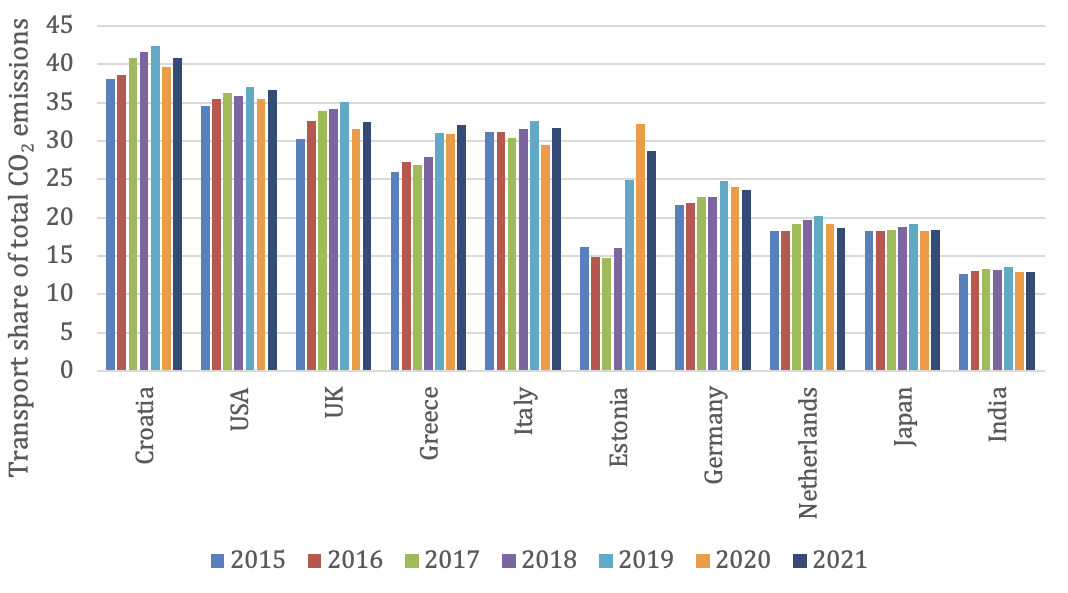
Next, we examine the practical relevance and suitability of the objectives, priorities and measures adopted in various NTPs, considering key indicators of the countries related to the intersection between transport and sustainable growth. First, we examine the share of CO2 emissions from transport in total CO2 emissions for each country to understand the relative contribution of each country’s transport sector to climate change (Figure 1). In this way, useful inferences can be made about the degree of the transport intensity and the dependence of an economy on transport. This indicator also reflects the country’s capacity to efficiently manage transport to decouple its economic growth from transport based on fossil fuels (Gómez et al. 2024). In most cases, we observe a stable trend which points slightly upwards for each country regarding the percentage of CO2 emissions from transport compared to the total national CO2 emissions. Only Estonia and Greece show a significant and concerning trend upwards, despite the global adverse COVID-19 pandemic impact on transport output (Bouzaghrane et al. 2024). This outcome means that, during the period 2015-2021, the transport sector of Estonia and Greece substantially increased their relative negative contribution to climate change or, that other sectors of their economies have decreased their proportion of CO2 emissions and transport sector did not keep up with this change.
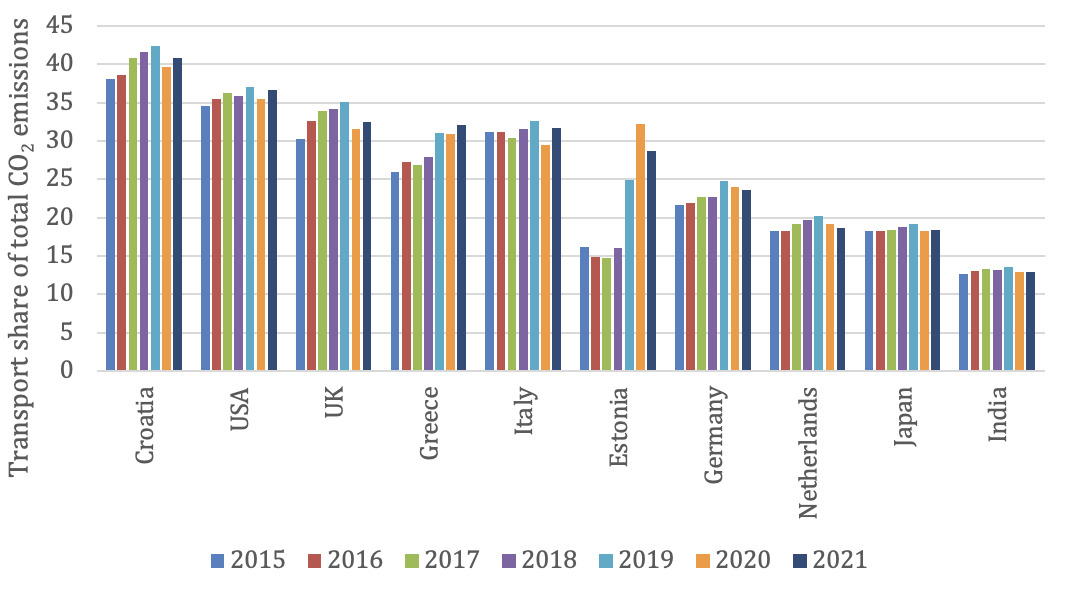
Some EU countries, including Croatia, Greece, Italy and Estonia, show higher transport emission shares than the EU average due to structural and economic factors. In Estonia, high transport emissions are linked to heavy reliance on road vehicles, a relatively old vehicle fleet, high car ownership, and limited emission reductions under current policies compared with other member states (OECD 2024). In Croatia, lower uptake of cleaner technologies, longer freight distances on road networks, and slower modal shifts toward rail or low-carbon alternatives contribute to higher CO₂ intensity in freight transport relative to the EU average. Similarly, in countries of southern Europe like Greece and Italy, there is a strong reliance on road transport, especially for freight, and increased dependency on private car and diesel-powered heavy duty vehicles, with limited public transport (outside the large urban cores) and railway coverage, which is intensified due to the presence insular/island areas and increased tourism pressure, while transport decarbonization is falling behind other sectors of the economy (Eurostat 2025). It should be noted here that the percentage of a country’s contribution to global CO2 emissions should not be overlooked. Namely, at a global level, even a small percentage increase in the emissions of Germany’s or USA’s transport sector would have more impactful consequences compared to a larger percentage increase of a low-contributing country, in terms of global CO2 emissions, such as Greece, Croatia and Estonia. Overall, each country should strive for turning this trend downwards, meaning that the national transport sectors should contribute less to the total national CO2 emissions over time.
Next, we examine the percentage of population in large metropolitan or functional urban areas (FUAs) in some of the selected countries that has access to public transport within ten minutes of walking travel time (Table 3). This performance index can offer useful insight into the accessibility, convenience, inclusivity, and density of a public transport system. The public transport system of Athens metropolitan area is found to be widely accessible overall, as 92.1% of the population has access to it within ten minutes of walking travel time from their location. This percentage is attributed to the dense bus service network, which offers access to public transport to most of the population that lives in Athens metropolitan area. Nonetheless, in terms of access to the metro or tram, the percentage is only 22.5% for Athens. Hence, the responsible authorities should probe the possibility of upgrading or expanding the fixed-route public transport network to increase their accessibility. The metropolitan area of Berlin is found to have the best performance in fixed-route mode service accessibility in the given sample, since approximately one out of two inhabitants has access to metro or tram within ten minutes from their location.
6. Conclusions-Policy Implications
The present paper reviewed and comparatively analyzed the NTP and transport strategies of Greece in relation to those of other countries in the EU and outside EU, giving particular emphasis on criteria linked with sustainable development and urban mobility. Regarding the Greek NTP, one of the key objectives is the mitigation of the negative environmental impact of transport, through promoting electric vehicles and relevant electromobility infrastructure, and expanding and upgrading the railway network, through advanced rail management systems and new rolling stock. In addition, it proposes improvements in the port and airport infrastructure, alongside the adoption of green technologies and practices. Another key element of the plan is the establishment of a legal framework for urban mobility planning and the development of SUMPs. However, it can be argued that in the Greek NTP, like most other NTPs, further emphasis should be given to critical aspects of freight transport and supply chains which are mostly overlooked, compared to passenger transport. Among others, such aspects include the development of urban delivery plans and consolidation centres, and interregional transport logistics hubs, together with their connection with the main railway network and international port facilities, and their integration with urban logistics systems (Tsekeris 2016).
The relevant international experience and the relatively low performance of the transport sector to reduce its share of CO2 emissions suggest that Greece should reinforce efforts toward electrification and the integration of renewables in the transport energy mix, for instance, through subsidies and investment for promoting the smart and solar-powered charging stations across urban areas and along the national road network. Besides, it must promote the facilities for active transport modes and improve the conditions of access to the metro or tram services, through expanded feeder bus routes, safe pedestrian walkways, protected cycling lanes leading to stations, bike parking and shared mobility hubs. At the same time, the country should establish common (metropolitan-level) transport governance structures for better coordination among various competent authorities and integration of transport with land-use planning to promote growth around transit corridors and stations. Relevant policy instruments include the encouragement of high-density mixed-use developments within walking distance to stations, the provision of affordable housing near transit hubs, and the delivery of sustainable mobility impact assessment for new developments.
Other policy proposals encompass the obligatory implementation of SUMPs into all tiers of local administration, the promotion of public participation in transport planning, and the enhancement of strategic planning and life-cycle asset management capacities via training programmes and education reforms (ITF 2018). Greece should also adopt policies and incorporate technologies in crucial issues related to how transport can facilitate the management of natural disasters and address supply chain disruptions due to geopolitical risks, pandemics and other unexpected events. Such policies may encompass the deployment of a unified crisis management framework linking transport, civil protection, and defense authorities, the development of green and climate-resilient transport infrastructure, and the pre-designation of evacuation routes and logistics corridors for disaster response.
The European NTPs align with relevant core EU policies, such as the European Green Deal, the TEN-T, and the Sustainable and Smart Mobility Strategy. Moreover, the NTPs of the EU and non-EU countries are found to be influenced by global agreements and initiatives to mitigate transport pollutant emissions, address climate change and diminish traffic congestion and consumption of fossil fuels. In all countries considered here, investment in metro lines and other (fixed-route) public transport infrastructure is regarded as high priority for promoting the efficient, resilient, fair and environmentally sustainable mobility in urban areas. Modern technologies and innovations do also play a key role as well as policies placing emphasis on more vulnerable transport users.
The comparison and findings could potentially be used for transport policy transfer among countries, either through adoption of similar policies or adaptation to local national contexts. Further research could examine the long-term impact of the contemporary transport plans and policies after collecting data for a lengthy period, such as a decade or more. Case studies could also be carried out to identify specific policies that proved to be highly effective to address main challenges and crises influencing the transport sector in the medium and the long term, and investigate whether they can be adopted and transferred to different place settings around the world. The cross-country comparison of NTPs could also benefit from the collection and processing of key data, for instance, about traffic flows and pollutant emissions (Thomsen and Schulz 2024) as well as budget allocations across transport modes and other expenditure categories over the planning period so that we detect complementarity and/or competitive relationships among them (Tsekeris 2014).
From an administrative perspective, it would be interesting to see how different governance structures adopt new transport policies and how effective they are in implementing them. Additionally, it would be worth studying the level of participation needed regarding the various stakeholders for successful implementation of transport policy. Moreover, from a financial point of view, future research could focus on the economic impact of policies that support sustainable development and urban mobility, while also assessing the best and most efficient mechanisms for the sustainable funding of these policies. Lastly, based on the Council of the European Union Recommendation of 16 June 2022 on ensuring a fair transition towards climate neutrality, it would be interesting to study the potential social consequences of the transition to a climate-neutral transport system, in terms of the equitable passenger and freight accessibility to insular/island areas (Tsekeris 2023), and the reduction of inequalities concerning income, employment, affordability and living conditions.